Your English is good.
It just doesn’t sound like you.
Precision English with the Flâneur: coaching for C1/C2 speakers who are done with close enough.

You understand the words.
You follow the conversation.
You’ve passed the exams.
And you still walk away from certain rooms feeling like you left the best version of yourself at the door.
Not because your English failed you,
because something underneath it did.
The half-second delay
The joke lands. Everyone laughs. You smile a beat too late; not because you didn’t understand, but because by the time you’d processed the register, the cultural weight, the implication underneath it, the moment was already gone. You were following the conversation. You were never inside it.
The approximate version
You said what you meant. Almost. There was a more precise word, a more exact shade, the version that would have made them lean in instead of nod politely. You felt it the moment it came out. Close enough isn’t the same as right, and you know the difference. That’s the problem.
The room you went quiet in
You had something to say. A strong opinion, a sharp observation, something that in your native language would have made people listen. In English you held it. Not because you lacked the words. Because you weren’t sure of the rules: how direct, how much irony, when to push. So you watched instead. And nobody at that table knew what they missed.
You’re already advanced.
This is for the person who speaks English every day, in professional settings, with educated native speakers, but still feels like something is missing.
Like the language is a slightly wrong-sized suit you’ve been wearing for years.
You’re the type of person who notices the gap between what you expressed and who you actually are. And that gap bothers you in a way it doesn’t bother most people; because most people stopped caring long before you did.

You don’t need motivation or vocabulary.
You don’t need someone to tell you your English is good.
You need someone who can see exactly what’s in the way and go straight for it.
You speak on what actually matters to you.
Not the topics you think you’re supposed to discuss. Not the safe, rehearsed version of yourself. The conversations you actually want to have; in English, with the same depth, the same personality, the same worldview you bring in your native language.
Precision, not more vocabulary.
The difference between the word you used and the word you actually meant. The subtle shade of meaning that an educated native speaker feels in half a second and can’t explain. That’s what we work on. Not lists. Not exercises. The exact version of the idea you have in your head.
You drop the social mask.
The one that appears the moment you switch to English. We unpeel it. What’s underneath is the person native speakers actually want to be around; and the one you’ve been trying to get to all along.
And finally: The invisible layer.
Register. Subtext. Cultural references. The social expectations of educated native speakers; which ones to follow and which ones to break. The stuff no textbook covers because most teachers don’t even know it exists. This is what makes you feel like a fish in the sea in English-speaking culture instead of a visitor.
I’m Dr. Yohann Brultey.
I grew up in a small working-class town in northeast France where nobody spoke English. I spent years wanting to get inside something that kept saying no. Public education gave me the path out.
I taught in Vietnam, Mexico, Spain, France, and the United States. I wrote a PhD in American literature. I coached native speakers on their own language. I fell in love with an American and built a life with her in a language I was never supposed to fully own.
At some point I stopped feeling like a guest in English and started feeling like myself. That’s what I want for the people I work with.
- Ph.D. in English, University of Versailles / Georgia State University — Summa cum laude
- Cambridge CPE, Grade A — Cambridge CELTA, Grade A
- Group Learning Experience Manager, Apollo English Vietnam
- Faculty Lecturer, Hong Bang International University, Ho Chi Minh City
- Academic Coordinator, Colegio Columbia, Mexico City

Jordi came to me two weeks before his TOEFL in a panic. We worked together. Then he walked into a networking event at Soho House in Hong Kong and felt more at ease than anyone else in the room. Then he went to the United States, attended lectures at Georgetown, and educated native speakers had no idea he was Spanish. Click here to read his testimony.
“My turning point was when everyone started saying: ‘Hey, I don’t know what happened, but your English now sounds like English.’ […]
Now I can use English the way I use my native languages: with sarcasm, with jokes, adapting the language naturally. People fully understood me: not just the language, but my personality. Before working with him, that felt impossible.”
Precision English with Yohann
3-Month Group Programme
The format
A small group. Six to eight people. Twelve weeks. Built around four pillars: precision of meaning, voice and ownership, the invisible layer, and phonological precision: the layer that makes even the right words land wrong when the stress and rhythm signal foreigner.
What you get
Weekly group sessions. A 2-hour 1:1 onboarding call. Individual voice note feedback throughout. Access to American native speakers for two sessions where you get their actual impressions of you; not just your English.
This is not a course
There are no modules to complete at your own pace. It’s live, it’s precise, and it’s built around who you actually are.
Applications open for the next cohort. If this sounds like you, get in touch.
- Every programme, every session, every piece of feedback, every roadmap is delivered by me, personally. No AI. No templates. No one-size-fits-all. Just work that is built around you.
Not sure yet? Fair enough.
Start here. Five days, zero euros, zero commitment. If it doesn’t change how you think about teaching pronunciation, nothing lost.
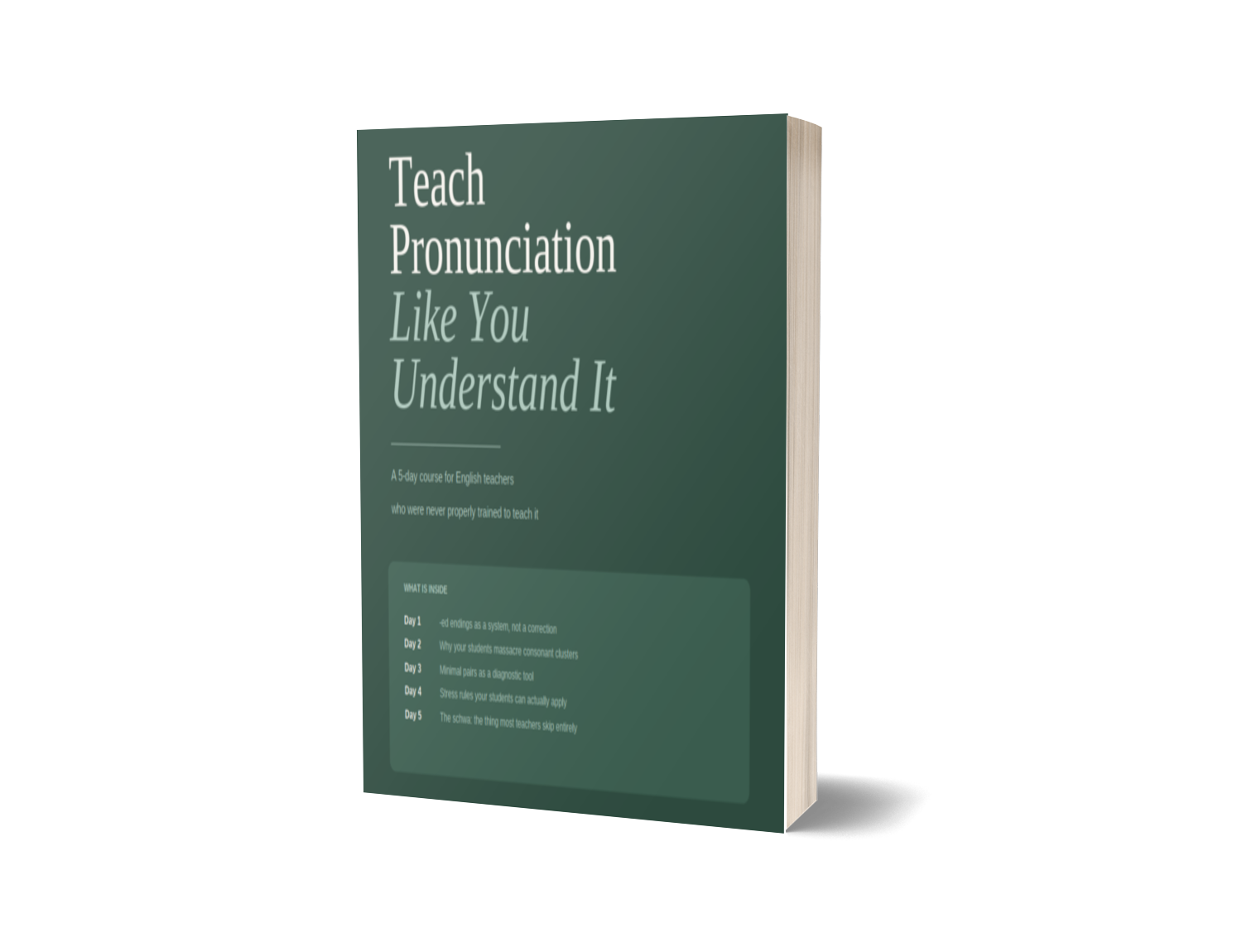
- Understand the vowel system well enough to explain it, not just model it
- Teach word stress and sentence stress as a coherent, learnable system
- Stop correcting by ear — start correcting with understanding